Death penalty report 2023

Overview
This report covers the judicial use of the death penalty for the period January to December 2023. As in previous years, information is collected from a variety of sources, including: official figures; judgements; information from individuals sentenced to death and their families and representatives; media reports; and, as specified, other civil society organizations. Amnesty International reports only on executions, death sentences and other aspects of the use of the death penalty, such as commutations and exonerations, where there is reasonable confirmation. In many countries governments do not publish information on their use of the death penalty. In China and Vietnam, data on the use of the death penalty is classified as a state secret.
During 2023, little or no information was available on some countries – in particular Belarus and North Korea – due to restrictive state practice. Therefore, for a significant number of countries, Amnesty International’s figures on the use of the death penalty are the minimum recorded. The true overall figures are likely to be higher.
Resource details
Publication date
Resource type
Download
-
Download: Amnesty Death Sentences and Executions Report 2023 (1.8 MB PDF)
-
Download: Amnesty Death Sentences and Executions Map 2023 (1.3 MB PDF)
Key statistics
A total of 1,153 executions took place in 2023, which does not include the thousands believed to have been carried out in China, marking an increase of more than 30% from 2022. It was the highest figure recorded by Amnesty International since 2015, when 1,634 people were known to have been executed. Despite this increase, the number of countries that carried out executions reached the lowest figure on record with Amnesty International.
“The huge spike in recorded executions was primarily down to Iran. The Iranian authorities showed complete disregard for human life and ramped up executions for drug-related offences, further highlighting the discriminatory impact of the death penalty on Iran’s most marginalized and impoverished communities,” said Agnès Callamard, Amnesty International’s Secretary General.
“Despite the setbacks that we have seen this year, particularly in the Middle East, countries that are still carrying out executions are increasingly isolated. Our campaigning against this abhorrent punishment works. We will continue until we have put an end to the death penalty.”
There was a 20% increase in the number of death sentences handed out globally in 2023, taking the total to 2,428.
Executions in Iran soar
In Iran, the authorities intensified their use of the death penalty to instil fear in the population and tighten their grip on power, carrying out executions across the country. At least 853 people were executed, marking a 48% rise from 576 in 2022. The executions disproportionately impacted Iran’s Baluchi ethnic minority who accounted for 20% of recorded executions even though they make up around 5% of Iran’s population. At least 24 women and at least five people who were children at the time of the crime were executed.
Of the recorded executions in Iran, at least 545 were unlawfully carried out for acts that should not result in the death penalty under international law, including drug-related offences, robbery and espionage. Execution for drug-related offences surged and constituted 56% of recorded executions in 2023, an increase of 89% from 255 executions recorded in 2022.
State secrecy
Due to state secrecy, Amnesty’s numbers do not include the thousands of people believed to have been executed in China, which remains the world’s lead executioner. Similarly, the organization was unable to put forward figures for North Korea and Viet Nam, countries believed to resort to executions extensively.
However, the limited number of official reports that did emerge from these countries sent clear messages to the public that crime or dissent would be punished by death, showing that the death penalty continued to be a tool in the state weaponry to maintain control and repress dissent.
In China, reports in state media were used to remind people that crimes such as drug trafficking and bribery would be harshly punished and result in execution, while North Korea published a new law that included the death penalty as possible punishment for those who did not use the native Korean language. Meanwhile, military authorities in Myanmar continued to impose death sentences in military-controlled courts, in secretive and grossly unfair proceedings.
Despite setbacks, progress continued
Despite the actions of a few, progress continued. As of today, 112 countries are fully abolitionist and 144 in total have abolished the death penalty in law or practice.
Executions were recorded in 16 countries, the lowest number recorded by Amnesty International. No executions were recorded in Belarus, Japan, Myanmar and South Sudan, all of which carried out executions in 2022.
In Asia, Pakistan repealed the death penalty for drug-related offences, while the mandatory death penalty was abolished in Malaysia. The authorities of Sri Lanka confirmed that the President did not intend to sign execution warrants, abating concerns of executions resuming.
“The inherent discrimination and arbitrariness that marks the use of the death penalty have only compounded the human rights violations of our criminal justice systems. The small minority of countries that insist on using it must move with the times and abolish the punishment once and for all,” said Agnès Callamard.
“The death penalty will again come under scrutiny at this year’s UN General Assembly. Amnesty International urges all governments to rally behind the UN’s call to end the use of the death penalty in a vital show of commitment to human rights.”
Although no country abolished the death penalty in sub-Saharan Africa, bills to abolish the punishment remain pending in Kenya, Liberia and Zimbabwe. In Ghana, the Parliament voted in favour of two bills that removed the death penalty from current legislation but, by the end of 2023, the bills had not yet become law.
-
 Death penalty report 2024
This report covers the judicial use of the death penalty for the period January to December 2024.
Reports and publications 07 Apr 2025 -
 Death penalty report 2022
A global look at the state of the death penalty in 2022 - its use, legal issues, regional differences, resumed practices, and continued momentum toward abolition.
Reports and publications 18 May 2023


Related content
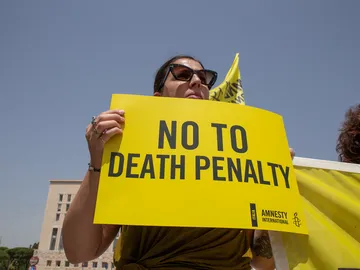
We stand against anyone - including any government - having the right to take away someone else’s life. We won’t stop until every country has abolished it. Explore our work to end the use of the death penalty around the world.
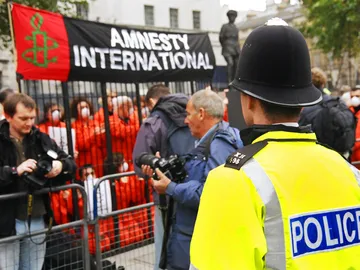
Ordinary individuals around the world are facing imprisonment, torture, and even death just for their beliefs, their job, who they love and even who they are. Find out how you can help us fight for their freedom.