Death penalty report 2024

Overview
This report covers the judicial use of the death penalty for the period January to December 2024. Amnesty International’s monitoring shows an increase by 32% in recorded executions compared to 2023. This does not include the thousands of people believed to have been executed in China, as well as in North Korea and Viet Nam, also believed to have resorted to executions extensively. For the second consecutive year, executing countries reached the lowest number on record.
Resource details
Publication date
Resource type
Download
Summary
Amnesty International’s monitoring of the global use of the death penalty recorded 1,518 executions in 2024, an increase by 32% from 1,153 in 2023. For the second consecutive year, executing countries reached the lowest number on record.
The global spike in known executions was due to a considerable rise in the numbers recorded in Iran, Iraq and Saudi Arabia, where executions increased altogether from 1,041 in 2023 to 1,380 in 2024. This constitutes approximately 91% of all known executions globally.
Compared to 2023, significant increases in executions were also recorded in Egypt, Singapore and Yemen, while a marginal decrease was recorded in Somalia. The use of state secrecy and other restrictive practices in China, North Korea and Viet Nam, among other states, continued to impair accurate assessments of the use of the death penalty.
Amnesty International recorded 637 executions for drug-related offences, representing over 42% of all known executions. While international human rights law prohibits the use of the death penalty for crimes that do not meet the threshold of “most serious crimes” (crimes involving intentional killing), at least four countries – China, Iran, Saudi Arabia and Singapore – carried out executions for drug-related offences in 2024. No confirmation was available for Viet Nam.
However, some notable advancements towards abolition were made. Zambia acceded to the Second Optional Protocol to the International Covenant on Civil and Political Rights aiming at the abolition of the death penalty, while Zimbabwe abolished the death penalty for ordinary crimes. More than two thirds of all UN member states also voted in favour of the tenth General Assembly resolution on a moratorium on the use of the death penalty.
Amnesty International opposes the death penalty in all cases without exception.
-
 Death penalty report 2023
This report documents the global use of the death penalty in 2023, noting that figures are based on confirmed cases and likely understate the true scale due to state secrecy and restricted information.
Reports and publications 29 May 2024

Related content
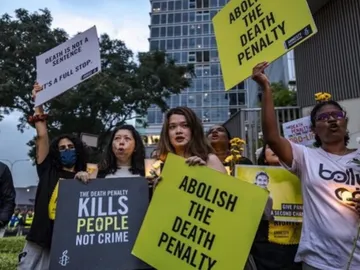
Iran, Iraq and Saudi Arabia responsible for 91% of executions
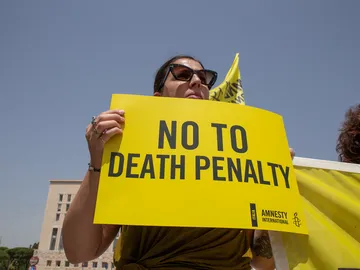
We stand against anyone - including any government - having the right to take away someone else’s life. We won’t stop until every country has abolished it. Explore our work to end the use of the death penalty around the world.
Ordinary individuals around the world are facing imprisonment, torture, and even death just for their beliefs, their job, who they love and even who they are. Find out how you can help us fight for their freedom.