

Press releases
Iran: Massacre of protesters demands global diplomatic action to signal an end to impunity
Verified videos and credible information from eyewitnesses in Iran reveal mass unlawful killings committed on an unprecedented scale amidst an ongoing internet shutdown imposed by the authorities since 8 January to conceal their crimes, Amnesty International said today.
The organization is urging UN Member states to recognize that systemic and continuing impunity for the crimes committed by security forces in current and past protests has emboldened Iranian authorities to persist in their criminal conduct. Since 28 December, the escalating lethal repression to crush the mostly peaceful uprising has led to the unprecedented loss of life during protest dispersals, with the death toll rising to 2,000 by official admission.
UN member states must take immediate and coordinated action to deter further bloodshed, including by convening special sessions at the UN Human Rights Council and the UN Security Council. To signal an end to the era of impunity and to deter further bloodshed, member states should also consider establishing international justice mechanisms aimed at pursuing prompt criminal investigations and prosecutions of those who have committed crimes under international law and gross human rights violations. States must also call on the Security Council to refer the Iran situation to the International Criminal Court (ICC).
“This spiral of bloodshed and impunity must end. Even by the Iranian authorities’ own bleak record of committing gross human rights violations and crimes under international law during successive waves of protests, the severity and scale of killings and repression since 8 January is unprecedented,” said Agnès Callamard, Amnesty International’s Secretary General.
“As large sectors of Iranian society flooded the streets braving bullets, Iran’s Supreme Leader and security forces have waged their deadliest crackdown yet. The authorities have deliberately turned to mass killings of protesters who have been demanding fundamental change and transition from the Islamic Republic system to a new system of government which respects peoples’ human rights and dignity. The international community must take urgent diplomatic action to protect protesters from further massacres and confront the impunity that is driving the state policy of bloodshed.”
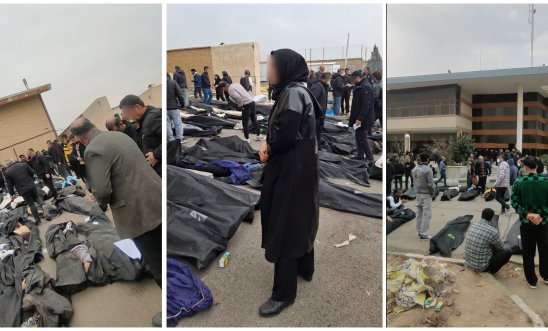
According to evidence gathered by Amnesty International, security forces positioned on the streets and rooftops, including of residential buildings, mosques and police stations, have repeatedly fired rifles and shotguns loaded with metal pellets, targeting unarmed protesters frequently in their heads and torsos. Medical facilities are overwhelmed with the injured while distraught families have been searching for their missing loved ones among body bags near overflowing morgues and witnessed bodies piled up in pick-up trucks, freight containers or warehouses.
Amnesty International has analysed dozens of videos and photographs pertaining to the protest crackdowns since 8 January from 10 cities in the provinces of Alborz, Gilan, Kermanshah, Razavi Khorasan, Sistan and Baluchestan and Tehran. The organization also consulted an independent pathologist regarding photographs and videos showing fatal or severe injuries.
Human rights defenders and journalists outside Iran shared with Amnesty International screenshots of text or voice messages from 38 individuals in 16 cities across nine provinces in Iran. Additionally, the organization spoke to three informed sources in Iran, including a medical worker and two protesters, and 16 informed sources outside Iran including victims’ relatives, human rights defenders, journalists and an eyewitness who left Iran on 12 January.
The evidence gathered by Amnesty International points to a coordinated nationwide escalation in the security forces’ unlawful use of lethal force against mostly peaceful protesters and bystanders since the evening of 8 January.
According to video analysis and eyewitness accounts, security forces involved in the deadly crackdown include the Islamic Revolutionary Guard Corps (IRGC), including its Basij battalions, and various divisions of Iran’s police force, known by its Persian acronym FARAJA, as well as plain-clothes agents.
Verified audiovisual evidence depicts severe and, in some cases, fatal injuries, including gunshot wounds to the head, including eyes, as well as individuals lying motionless on streets or being carried away amid what is believed to be continued sound of gunshots. Other footage shows patients bleeding profusely or appearing lifeless on hospital floors. In several videos, the people filming state that individuals have been killed.
At least two videos show security forces chasing and directly firing at fleeing protesters who appear to pose no threat warranting the use of force, let alone firearms or other prohibited weapons.
In an account shared with Amnesty International, a journalist from Tehran said:
“Tell the world that unspeakable crimes are being committed in Iran… Tell the world that if they do nothing, they [authorities] will turn the country into a graveyard.”
The ongoing internet shutdown has severely impeded the ability of victims, journalists and human rights organizations to conduct in-depth interviews and document violations, increasing the risk that evidence will be lost.
Amnesty International renews its call on Iran’s top security body, the Supreme National Security Council, to immediately issue orders for security forces to stop the unlawful use of force and firearms and immediately restore full internet access.
It is long overdue for states and the international community to pursue comprehensive international justice and to address the decades-long and systemic impunity that has enabled Iranian authorities to persistently commit crimes under international law and to eradicate dissent and deny findings on crimes against humanity by the UN Fact Finding Mission on Iran. Such a comprehensive justice approach requires international responses, including an ICC investigation (following a referral by the UN Security Council) and the establishment of international justice mechanisms for Iran, as well as coordinated national-level responses through states undertaking criminal investigations and prosecutions pursuant to the principle of universal jurisdiction.
Tehran province
Evidence from verified videos and eyewitness accounts reveal that security forces carried out mass unlawful killings across Tehran province.
On 10 January 2026, distressing footage began to emerge of a makeshift morgue set up in an outbuilding of the Legal Medicine Organization (a state forensic institute) in Kahrizak, near Tehran, as an overflow of the official morgue inside the building. Five videos from this morgue show distraught families seeking to identify their deceased relatives among the body bags. Amnesty International analyzed the five videos and, after accounting for potential duplication across the footage, identified the presence of at least 205 distinct body bags.
One of the videos, published on 11 January 2026, shows a screen inside the facility displaying photos of the deceased, with a changing numerical counter. This appears to be a method adopted by the authorities to enable families to identify their deceased relatives. The counter reaches 250, indicating the staggering number of bodies being processed.
A report published by BBC Persian on 13 January 2026 includes the account of an eyewitness in Kahrizak, who described the scene on 9 January:
“They [victims’ families] reached an autopsy hall where bodies were piled on top of each other… There was one room that was so full of bodies the door would not even open… Another room contained the women’s bodies.”
Information sent from three informed sources indicates that, in addition to this central morgue in Kahrizak, victims’ relatives are being directed to cemeteries and hospitals, where bodies have been kept in warehouses and freight containers.
A video filmed at the Behesht Zahra Cemetery complex in Tehran and shared with Amnesty International shows families looking for loved ones among body bags laid outside and in multiple large rooms inside the complex. It is unclear when the video was filmed but the person filming says the bodies were brought in after the violent crackdown on 8 and 9 January 2026. Amnesty International analyzed the video and four photographs showing bodies placed in black bags and counted at least 120 body bags. The organization spoke to a victim’s relative who went to the morgue on 9 January to retrieve the body and described harrowing scenes with the cemetery’s morgue overflowing with dead bodies.
Earlier videos from Tehran province show how the deadly crackdown unfolded. A video published on 9 January 2026 shows 10-12 bodies inside Alghadir Hospital in the east of Tehran.
A video published two days later from Tehranpars, a neighbourhood about one kilometre from Alghadir Hospital, depicts the deadly crackdown in this area of Tehran. The embedded text in the video states that it is from 8 January 2026, but Amnesty International could not independently corroborate the exact date the video was filmed. In the video, two protesters appear to be taking cover amid the sounds of continuous gunfire in Rashid 115 Street. The protesters are not visible but one is heard warning the other who is filming:
“Put your phone down. They will shoot your hand. There are snipers among them [security forces].”
A six-minute video filmed in Rashid 115 Street in Tehranpars on 9 January 2026 also shows security forces firing from the rooftop of a police station as protesters and bystanders flee.
An eyewitness from the nearby neighbourhood of Narmak said:
“In the Narmak neighborhood, they [security forces] shot and killed at least five or six people in front of us. They have stopped using metal pellets and are shooting with live ammunition.”
Another eyewitness said they saw many people with gunshot wounds brought into Labbafinejad Hospital in north-east Tehran. According to information received by Amnesty International, medical workers reported similar situations in a hospital in Shahr-e Qods, Tehran province, and a hospital near the Sadeghieh (Arya Shahr) neighbourhood in Tehran city.
In an account shared with Amnesty International, a protester from the town of Nassimshahr, said:
“They [security forces] relentlessly fired on people as they were fleeing. They killed… people on [8 January]. They also fired at everyone on [9 January] and killed… people. Tell the whole world. At every step, teenage-looking Basij agents were positioned, armed with Kalashnikov rifles.”
Razavi Khorasan province
Verified video evidence from 8 January 2026, corroborated by accounts from eyewitnesses and medical workers, indicates that security forces in Razavi Khorasan province, fired directly and without warning at protesters and bystanders, reflecting a serious escalation in the use of lethal force amid reports of a high death toll in the province.
A medical worker from Mashhad interviewed by Amnesty International told the organisation:
“On the night of 9 January, the deceased bodies of 150 young protesters were brought into one hospital and then taken to Behesht Reza Cemetery near Mashhad. A young, injured woman died in the hospital and security forces wanted to announce that she was killed by rioters, which the family refused. [The authorities] buried people quickly in the cemetery before they were even identified and then notified their families afterwards.”
In one video, filmed in Vakilabad Boulevard in Mashhad on 10 January 2026, security forces firing at protesters from elevated positions, including footbridges. A second video filmed in the same area on the same date shows security forces pursuing protesters as sounds consistent with gunfire are heard. A visible flash appears among the agents, accompanied by a loud bang, and the person filming says the authorities are firing at people.
An eyewitness from Vakilabad recalled the security forces’ crackdown as follows:
“They were using tear gas and stun grenades and shot directly [at protesters]. They even fired tear gas inside people’s homes. They shot people with live ammunition in the Vakilabad area and several were injured. The people feel like they have nothing left to lose.”
Another medical worker from Mashhad whose account was shared with Amnesty International said:
“I work in the emergency department… Everyone they brought in had suffered horrific injuries from direct gunfire. Some had their heads and faces full of pellets. It was clear that they [security forces] were shooting with intent to kill. These heartless people have no mercy.”
Alborz province
Video analysis and eyewitness accounts also indicate mass killings of protesters and bystanders across Alborz province since 8 January.
In videos analyzed by Amnesty International gunfire is heard and, in one video filmed in Karaj and published on 10 January 2026, dozens of armed security forces are seen patrolling the street.
Two videos published on 9 January 2026 show multiple men and women motionless on the floor of what appears to be a hospital. In one, the person filming says: “They [security forces] have killed people with live ammunition.” The text in the video says that the images are from Fardis from 8 January 2026, but Amnesty International could not independently corroborate the exact date and location where the video was filmed.
Eyewitness accounts received from Alborz province confirm a deadly crackdown. One account received from a medical worker in Fardis describes an overwhelming influx of injured people and dead bodies into hospitals in Karaj:
“At Soleimani Hospital, on [8 January] night alone, 87 dead bodies were brought in... At Parsian Hospital, there were 423 injured people. It was crowded and there were many injured people.”
Kermanshah province
Eyewitnesses and verified audiovisual evidence from 8 and 9 January 2026 in Kermanshah province also reveal widespread patterns of security forces unlawfully using force, firearms and other prohibited weapons against protesters, causing killings and injuries, including in the cities of Kermanshah, Eslam Abad-e Gharb and Gilan-e Gharb.
Several verified videos published on 8 January 2026 show security forces in uniforms and plain clothes in Golha Boulevard and surrounding areas in the city of Kermanshah, carrying out violent arrests and maintaining a threatening presence. In one video, the sound of a shotgun being fired and reloaded is audible. The footage does not show the person targeted. In the second video, agents in uniforms and plain clothes are seen patrolling the streets with shotguns, as well as arresting one person.
Another video published on 8 January 2026 shows chaotic scenes of protesters in Kermanshah assisting two people injured on the ground, while the person filming shouts: “They have killed two people.”
In two videos from Gilan-e Gharib shared with Amnesty International by a human rights defender, gunshots are audible, including in one showing protesters fleeing as gunshots ring out.
The video evidence is corroborated by eyewitness accounts. Amnesty International received the account of an injured protester from the city of Kermanshah, saying:
“Kermanshah feels like a war zone. It’s a field of bullets. Officers came from the surrounding alleys and started shooting. We all ran, but the sound of gunfire is still coming. I was hit by 20 metal pellets and took refuge in a nearby house… The security forces even fired at the homes of people who sheltered those fleeing gunfire.”
Eyewitness accounts included urgent pleas for help. An eyewitness from the city of Gilan-e Gharb said:
“The situation is extremely dire. Do something; they [security forces] are shooting people with live ammunition… They have unleashed a bloodbath against the people. For the sake of your conscience, do whatever you can. Alert human rights organizations.”
ENDS
For more information or media requests please contact media@amnesty.org.uk