Education resources on freedom of expression

Empower students to defend and promote the right to freedom of expression.
Resources
These two downloadable lessons, created by Amnesty International and the Anne Frank Trust, explore human rights through the life and legacy of Anne Frank.
Students will learn about freedom of opinion and expression, examine a real case of repression, and engage with powerful writing.
Through discussion and creative activities, students are encouraged to think critically, challenge censorship, and take action for human rights.
The lessons are recommended together for students aged 14+, with the first lesson also suitable as a stand‑alone option for ages 11+.
Online Learning
This course introduces the right to freedom of expression and why it matters.
Learners explore what freedom of expression means, the common threats it faces, and how it can be defended in practice.
The course also encourages practical action, supporting learners to promote and protect this essential human right.
This short course will equip learners with the knowledge to understand and claim your right to freedom of expression, and the skills and confidence to take action to defend it.
This course is designed to help learners understand why protest is protected by human rights, how the freedom to protest is under threat throughout the world, and how they can defend their right to protest.
In this online course, learners will investigate the concept of protesting as a tool for social change, as well as how the freedom to protest is under threat.
This case study aims to help learners understand how ordinary citizens, whose protests were not authorised by Russian authorities, took their case to the European Court of Human Rights and won.
Learn how a group of activists in Georgia appealed to the European Court of Human Rights for a judgement in protecting their right to safely conduct a march against homophobia without fear of violent counter-demonstrations.
Build knowledge of human rights and British politics and learn key strategies to influence and advocate for human rights. In this free course, learners will gain deeper understanding of the UK political system and human rights to help you advocate for change.
The course will give learners a basic understanding of the international human rights laws and standards applicable in law enforcement. They will learn the fundamental human rights principles governing police work; and learn when police can use force (and when not), including the rules that should govern the use of different weapons, and how human rights compliant policing of protests should look like.
This online course is designed to help learners understand the right to Freedom of Assembly and Expression, from a UK perspective. In this free course they will investigate the concept of protesting as a tool for social change, as well as how the freedom to protest is under threat.
Learn why protest is protected by human rights, how the freedom to protest is under threat throughout the world, and how to defend our right to protest.

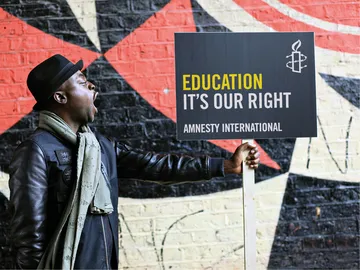
© Amnesty International / Photo: Henning Schacht
Looking for more?
The resources above are part of a wider collection created by our Human Rights Education team. Explore our Knowledge Hub for more education resources on freedom of expression.
Alternatively, head back to our Education Themes page for even more curated teaching resources on a range of topics.

Join our TeachRights mailing list
Would you like to receive the latest news about our Human Rights Education work, along with free resources, information on training opportunities, and more straight to your inbox?
Related content

Interested in our work in education, or looking to inspire your students to explore human rights with creative resources, activities, and real-world stories. For over 25 years, we’ve helped educators turn classrooms into spaces for action and change. Join us and make human rights part of every lesson.
Find education and training resources all in one place...

Freedom of expression in the UK protects the right to seek, receive and share ideas without interference, though restrictions exist to prevent harm and safeguard others.