AIUK Policy Briefing: The Weaponisation of VAWG and How to Respond

Overview
Alongside anti-racist and women’s rights organisations, Amnesty International UK has denounced the instrumentalisation of violence against women and girls (VAWG) by the far right and some elected officials, including MPs. This briefing provides guidance to understand and challenge these harmful narratives.
Resource details
Publication date
Resource types
Issues
Download
Violence against women and girls in the UK
VAWG is both a symptom and a cause of discrimination against women and a violation of human rights. Patriarchal social norms that value men over women, gender stereotypes and unequal power relations are the root cause of VAWG.
In the UK, rates of VAWG remain shockingly high. According to the National Audit Office more than 1 in 4 women will be victims of sexual assault or attempted sexual assault in their lifetime, while at least 1 in 12 women are victims of related offences each year. Incidents of gender-based violence against women and girls represented 20% of all recorded crimes in 2022/23. These estimates are just the tip of the iceberg as the vast majority of incidents go unreported. In England and Wales, in the year ending March 2025, only 15% of women victim of sexual assault or attempted sexual assault reported the crime to the police.
Amnesty International's recommendations
In addition to actively challenging malicious narratives weaponising VAWG, we urge the government to:
1. Withdraw guidance relating to the ethnicity and nationality of suspects. Show Hide
Amnesty International, alongside leading anti-racist organisations, has criticised recent government’s guidance to disclose the ethnicity and migration status of suspects in high profile cases for presenting to the public ‘a false and harmful impression that links ethnicity or migration status with criminality.’ We urge the government to withdraw this guidance.
2. Adopt comprehensive measures to discourage and combat xenophobic discourse. Show Hide
We echo the call from the UN Committee on the Elimination of Racial Discrimination to ‘adopt comprehensive measures to discourage and combat racist hate speech and xenophobic discourse by political and public figures.’ This includes ensuring that public authorities, including high-level public officials, distance themselves from hate speech and xenophobic political discourse.
3. Take action to address online-amplified violent far-right narratives. Show Hide
As we recommended in our analysis of the amplification of violence and hatred via platforms like X, the government must act to addresses major gaps in the enforcement of the current online safety regime to hold platforms accountable for the broader harms caused by their lack of controls that allow their engagement-driven algorithms to spread of hate content, threats, and false communications.
4. Implement measures to address VAWG. Show Hide
Implement the recommendations of GREVIO for the implementation of the Istanbul Convention and withdraw reservation to Article 59 in relation to residence status for victims whose status depends on a spouse or partner.
Want to find out more?
Read the full briefing via the download link above to learn more. You can also sign up to our Rights in Focus newsletter to make sure you never miss an update.
-
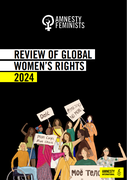 Global state of women's right - Amnesty Feminist Report
This report examines current challenges to gender equity faced by women worldwide, analysing eleven global regions alongside the online sphere as a distinct, increasingly influential space of discrimination and inequality.
Reports and publications 28 Nov 2024

Related content
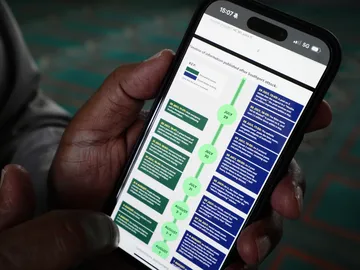
False claims on X (formerly Twitter) spread rapidly after tragic triple murder in Southport, contributing to violent racist riots across the UK. Amnesty International’s analysis links X’s design and policy choices to the amplification of content which…
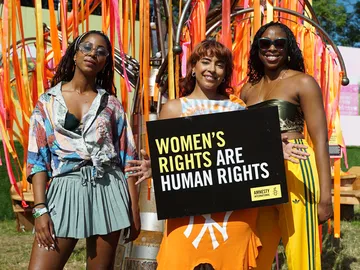
Women and girls experience violence and discrimination based on their sex and gender. When governments fail to protect them, Amnesty International helps to ensure that they can live in dignity, safety, and freedom.
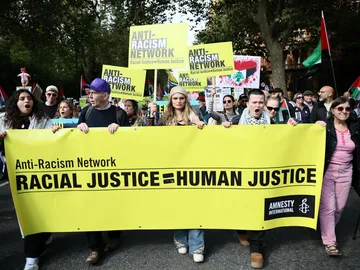
Government policies like the "Prevent" duty and use of "crime predicting" technology by police target racialised people and erode their human rights. The power to change this is in our hands.