Sanctioning Harm: Universal Credit in the UK

Overview
Amnesty International UK's latest policy briefing on the state of the nation's social security system, this time focusing on the Universal Credit scheme's sanctions regime ahead of proposed government reforms
Resource details
Publication date
Resource type
Issues
Download
Background
Amnesty International’s 2025 report, Social Insecurity, documented how failures in the UK’s social security protections, including cruel sanctions, trigger cascading violations of economic, social and cultural rights such as hunger, worsening mental health and homelessness. This briefing builds on that research to:
- Cast a spotlight on the UK government’s approach to social security sanctions
- Why it fails to comply with international human rights standards
- Make recommendations for legislative and policy reform.
Our briefing draws on available government data and a literature review of academic and civil society research, and restates first-hand evidence from claimants and advisors from across the UK – highlighting the systemic impact of sanctions on working-age claimants of Universal Credit.
Our recommendations
- Urgently end the cruel and dangerous sanctions regime which penalises claimants to the extent that they are unable to meet their basic needs
- Following a review, any new sanctions regulations must include the following:
- Financial assessment to determine the level of sanctions (such as an essential living standards test) to ensure that the level of social security does not fall below the level at which people can afford the essentials for living.
- Review the guidance for ‘vulnerability’ and ‘good reason’ and co-create stronger guidance with people with lived experience of claiming social security. Ensure this guidance is placed on a statutory footing, and no sanction is applied without full consideration of the safeguarding concerns and evidence submitted by a claimant.
- Ensure that there is independent oversight of the application of sanctions regulations to ensure transparency, compliance with the law and relevant legal principles, and that all claimants have access to mandatory reconsideration and appeals processes. The DWP must no longer be allowed to mark its own homework.
- The DWP implements the recommendation from the Work and Pensions Committee that it should introduce a statutory duty to safeguard vulnerable claimants. This duty should include a risk assessment, starting at the outset of claims, which considers factors such as the wellbeing of vulnerable claimants, their dependents, and preventing harm when exercising its functions.
- The DWP should be required to comply with an accessible information standard (similar to those applicable in health and social care provision) to ensure that reasonable adjustments are made as to the provision and communication of social security.

Prime Minister: Poverty is a political choice
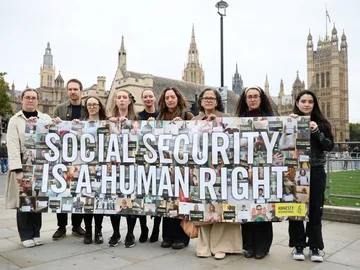
Right now in the UK, millions of people can’t afford the basics – food, rent, bills. That's why we're calling on the government to invest in social security and make sure everyone has enough to live on.
Sign the petition
Tell the Prime Minister that poverty is a political choice and he has the power to end it.
-
 Social Insecurity ReportReports and publications 17 Apr 2025

Related content
Our CEO, Kerry Moscogiuri, shares her thoughts on the implications of the 2026 Timms Review of the UK's Personal Independence Payment (PIP).

In response to the release today of the UK’s latest poverty statistics, Jen Clark, Amnesty International UK’s Economic, Cultural and Social Rights Lead, said: “Today’s figures are damning evidence of successive governments’ failure to ensure that every person in this country has the basics needed for a decent life.