Poland: LGBT rights under attack
Amnesty International are concerned about a climate of intolerance in Poland against the lesbian, gay, bisexual and transgender (LGBT) community, characterised by the banning of public events organised by the LGBT community, openly homophobic language used by some highly placed politicians, and incitement of homophobic hatred by some right-wing groups. We also note with concern the recent abolition of the government office responsible for promotion of equal treatment for sexual minorities.
Demonstration ban
On 15 November 2005, the mayor of the city of Poznan, Ryszard Grobelny, banned the Equality March, an event organised by Polish feminist and LGBT organisations that was set to take place later that month. The Equality March was intended to provide a platform for discussion about tolerance, anti-discrimination and respect for the rights of sexual minorities. The mayor justified the ban on the grounds of "security concerns", despite a previous agreement to change the route of the march in order to comply with security requirements.
Harrassment and intimidation
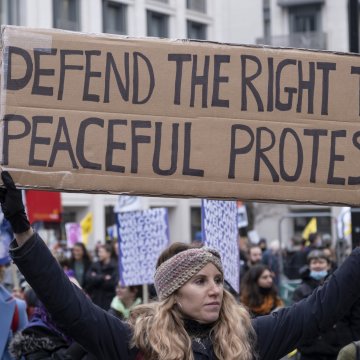
Despite the ban, a few hundred people gathered together on 20 November for a demonstration. They were reportedly harassed and intimidated by members of a right-wing grouping known as All Polish Youth (Mlodziez Wszechpolska), who allegedly shouted "Let's gas the fags" and "We'll do to you what Hitler did with Jews". The police intervened towards the end of the march in order to disperse it, reportedly roughly handling several individuals. They arrested and interrogated over 65 people, who were later released.
Not a one-off
The Equality March in Poznan in November 2004 was also interrupted when the police failed to provide protection to demonstrators from the members of the All Polish Youth who blocked the event; the Equality Parades in the capital, Warsaw, in June 2004 and again May 2005, were banned. When he refused for the second year running to authorize the Equality Parade in Warsaw in May 2005, the then mayor of the city, Lech Kaczynski of the Law and Justice (Prawo i Sprawiedliwosc) party - who was later elected the President of Poland - held that such an event would be "sexually obscene" and offensive to other people's religious feelings.
The improvised parade still took place on 10 June, gathering more than 2,500 participants. Less than a week after that, the mayor authorised the so-called "normality" parade, during which members of the All Polish Youth reportedly demonstrated on the streets of Warsaw and shouted slogans inciting intolerance and homophobia. In September 2005, a Warsaw court ruled that the mayor's decision to ban the Equality Parade was illegal.
Abolition of equality watchdog
The recent abolition of the Office of the Government Plenipotentiary for the Equality of Men and Women, which was responsible for promotion of equal treatment of sexual minorities, is very concerning. The abolition of the Office makes Poland the only country in the EU country without a statutory equality watchdog and puts into question its compliance with the EU legislation on prohibition of discrimination.
Poland's obligations
International law prohibits discrimination on any grounds and encourages states to introduce legislation that protects individuals from incitement to hatred. In particular, both the International Covenant on Civil and Political Rights (ICCPR) and the European Convention for the Protection of Human Rights and Fundamental Freedoms oblige states parties to guarantee all individuals the enjoyment of their human rights without discrimination on the basis of sexual orientation. Poland is a signatory to both these instruments and is fully bound by their provisions. Amnesty International calls on the Polish authorities to fulfil these obligations under international human rights law, including by explicitly prohibiting discrimination against sexual minorities, and investigating and penalising all public expressions of incitement of hatred and intolerance against sexual minorities. Members of the government and other leading politicians should not only refrain from public homophobic remarks, but exercise leadership to ensure that the fundamental rights to freedom from discrimination, freedom of expression and freedom of association are actively promoted, and work to build a society where they can be enjoyed by all.